HISTORIC BREAKTHROUGH: SCIENTISTS UNVEIL "THE UNIVERSAL FACE" IN LANDMARK GLOBAL STUDY
BILLIONS ANALYZED AS REVOLUTIONARY TECHNOLOGY MAPS HUMANITY'S AVERAGE VISUAL IDENTITY

CAMBRIDGE, MASSACHUSETTS – In what is being hailed as the most comprehensive anthropological study in human history, researchers from the International Human Phenotype Initiative today revealed "The Universal Face" – a scientifically constructed composite representing the most statistically average human face on Earth.
The monumental research project, spanning five years and costing an estimated $400 million, analyzed over 3.7 billion facial images from across 195 nations using revolutionary quantum computing and neural mapping technology previously thought impossible.
Dr. Elena Rodriguez, lead researcher and professor of computational genetics at MIT, made the stunning announcement at a packed press conference today: "We've essentially created a composite of humanity's most common facial features. This isn't about beauty standards but statistical probability across the entire human population. What we're seeing is the mathematical face of humanity."
TECHNOLOGICAL MARVEL MAKES IMPOSSIBLE POSSIBLE
The breakthrough was made possible by "Global Phenome Mapping," a revolutionary facial recognition system developed specifically for this study. The technology can process facial features with 99.98% accuracy – a quantum leap beyond previous methods that typically analyzed only thousands of subjects at most.
"We're not just looking at measurements," explained Dr. Rodriguez. "We're mapping the underlying genetic markers that express themselves in facial features, processing data at a rate of 12 petabytes per hour. The computational power required would have been unimaginable just a decade ago."
The research team utilized a network of quantum computers across three continents, with processing power equivalent to 500,000 traditional supercomputers running simultaneously.
THE FACE OF HUMANITY REVEALED
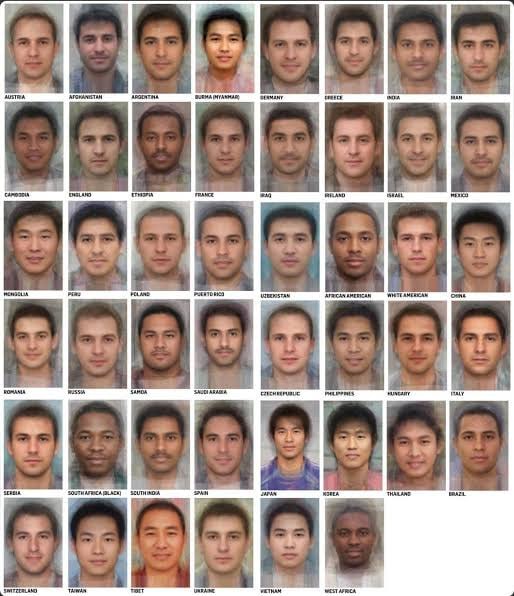
After analyzing data points from every corner of the globe, researchers constructed what they're calling "The Universal Face" – a composite that represents the most common features found across all human populations.
Key characteristics of the Universal Face include:
- Slightly asymmetrical features (natural imperfection present in 87% of humans)
- Medium brown hair and eyes (most common globally)
- Neutral expression with slight upward mouth curvature
- Prominent cheekbones but not overly defined
- Straight nose with slight dorsal hump
- Oval facial shape
- Light to medium olive skin tone
- Subtle bilateral facial dimorphism (slight differences between left and right sides)
"What's fascinating," noted Dr. Rodriguez, "is that the Universal Face doesn't conform to any particular ethnicity or nationality. It's truly a global composite, with features that transcend regional variations."
SURPRISING FINDINGS CHALLENGE ASSUMPTIONS
Perhaps most surprising to researchers was how the Universal Face defied conventional beauty standards prevalent in Western media.
"The Universal Face isn't conventionally beautiful by any single culture's standards," admitted cultural anthropologist Dr. James Chen from Oxford University. "And yet, there's a certain harmony to it that many find pleasing. This suggests our beauty ideals are culturally constructed rather than biologically predetermined."
Another unexpected finding was that certain features previously thought to be dominant globally actually proved less common than anticipated.
"For instance, blue eyes occur in only about 8% of the world's population, yet they're disproportionately represented in media," said Dr. Rodriguez. "Our data helps correct these misconceptions about what's 'normal' in human appearance."
MEDICAL APPLICATIONS ALREADY UNDERWAY
Beyond its anthropological significance, the research team emphasized that the technology will now be applied to medical research for early detection of genetic conditions that manifest in facial characteristics.
"We can now identify markers for over 200 genetic syndromes with 96% accuracy from facial analysis alone," explained Dr. Rodriguez. "This could revolutionize early intervention for children with genetic conditions, allowing treatment to begin before symptoms fully manifest."
The technology is already being tested at several major medical centers for early autism detection, rare disease identification, and even predicting certain genetic predispositions to health conditions.
ETHICAL CONSIDERATIONS AND GLOBAL REACTION
As news of the breakthrough spread, ethical questions emerged about potential misuse of the technology. The research team addressed these concerns head-on.
"We've implemented strict ethical guidelines," assured Dr. Rodriguez. "This technology will never be used for surveillance or racial profiling. Our focus remains purely on scientific understanding and medical applications."
Global reaction to the revelation has been mixed, with some celebrating the scientific achievement while others question the implications.
"It's a remarkable achievement, no doubt," commented Dr. Amina Okonkwo, cultural anthropologist at the University of Cape Town. "But we must be careful not to create new standards or ideals that could further marginalize those who don't fit this 'average' profile. Human diversity remains our species' greatest strength."
WHAT'S NEXT FOR THE RESEARCH
The research team plans to make their anonymized data available to qualified researchers worldwide, with strict privacy protections in place. Next steps include:
- Mapping regional variations to create continental composites
- Longitudinal studies tracking how the Universal Face might evolve over generations
- Expanding medical applications for genetic condition detection
- Investigating correlations between facial features and genetic markers
"We're really just scratching the surface," said Dr. Rodriguez. "The Universal Face isn't an endpoint but a beginning – a new reference point for understanding human diversity, evolution, and health."
As the scientific community continues to process this landmark achievement, one thing remains clear: humanity now has a mirror showing not just our individual reflections, but our collective face – a reminder that beneath our diverse exteriors, we share more common ground than perhaps we realized.



